
HAVE A Browse...
topics

Hi there!
MARKETING STRATEGIST.
MUM. DATA-LOVER.
STRAIGHT-TALKER.
I'm Kelly
I work with ambitious founders who want clarity, not chaos - & marketing that actually works.
This blog? It's where I share practical strategy, honest perspective, and the mindset shifts that make growth feel possible again.

Why You Need a Part-Time CMO in 2025
Growth HACKS

5 Easy Keyword Research Tips for Small Biz
SEO BASICS

Why You Need
a Marketing Audit
MarketING Audits

7 Ways to Market Without Money
Growth HACKS


A FEW FAVOURITES
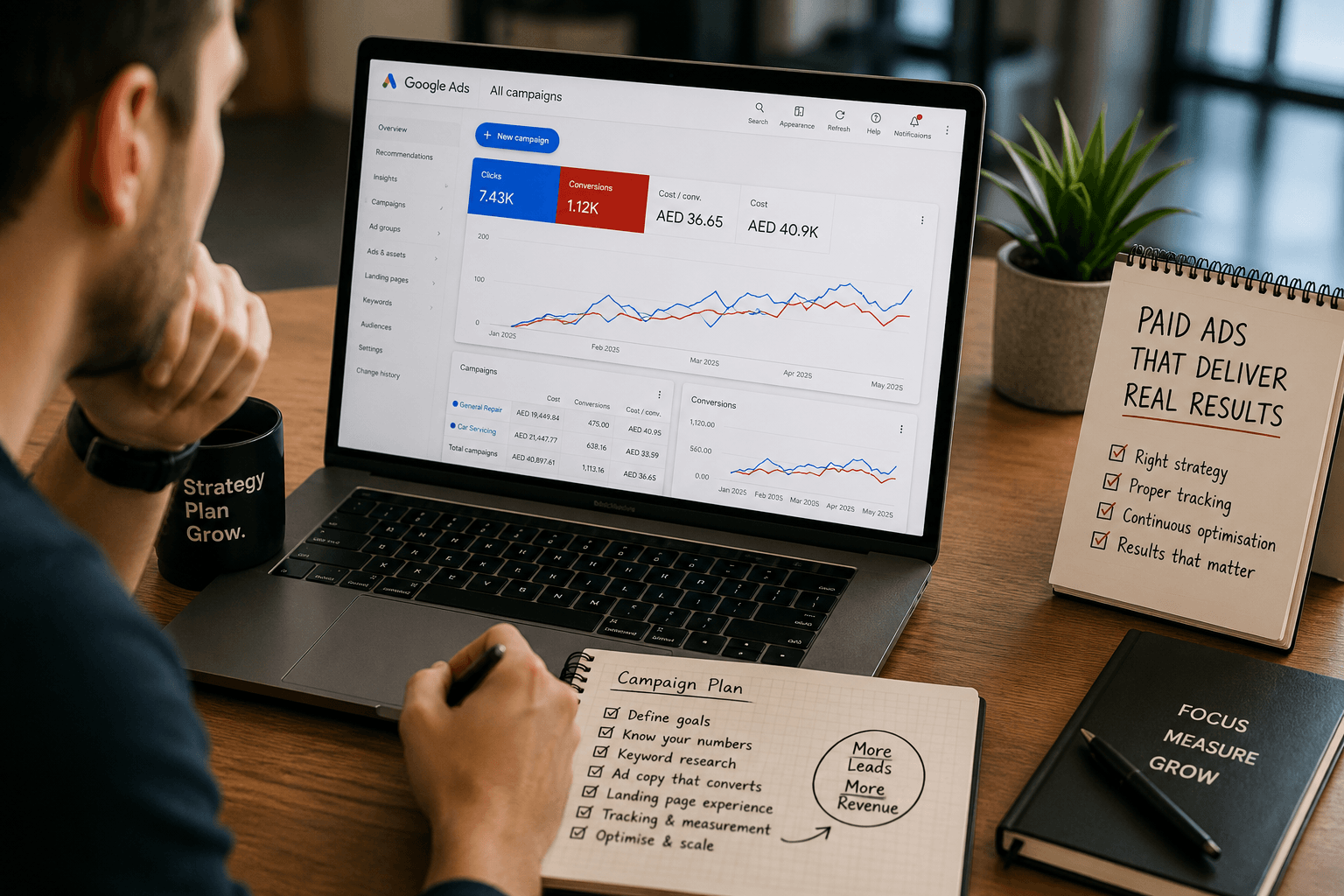
Paid Ads for Small Business: 5 Real Benefits (And What It Actually Takes to Get Them)
Jul 23, 2026
●
Most founders I speak to have already tried paid ads. Usually the story is the same: they boosted a few posts, ran a campaign for a month or two, spent a few thousand dirhams, and quietly turned it off because they couldn’t tell whether it had worked.
That isn’t a failure of paid advertising. It’s a failure of setup, tracking and patience – in that order.
Paid ads for small business owners are genuinely one of the fastest ways to put your product or service in front of people who are actively looking for it. But the benefits everyone talks about – visibility, targeting, speed, measurability, flexibility – only show up when the campaign is built properly and measured against real business outcomes, not platform vanity numbers.
Here’s what paid ads actually give you, what each benefit depends on, and what it costs to do it properly.
What “paid ads” actually means for a small business
Paid advertising covers two very different jobs, and mixing them up is where a lot of budget goes to die.
Search ads (Google) put you in front of people who are already looking. Someone types “car servicing near me” or “corporate gifting Dubai” and you appear. The intent is already there – you’re capturing demand, not creating it.
Social ads (Meta – Facebook and Instagram) put you in front of people who fit a profile but weren’t necessarily looking today. Brilliant for retargeting, for ecommerce, and for building awareness. Slower to convert cold.
Most small businesses need one of these done well before they need both. If you’re a service business generating enquiries, search usually earns its place first. If you’re an ecommerce brand with an existing audience and good creative, Meta often does.
Benefit 1: Visibility you don’t have to wait years for
SEO is essential, and I’ll always recommend it. But it compounds slowly. Paid search puts you on page one the day your campaign goes live.
For a small business competing against established names with bigger budgets and older domains, that matters. You don’t have to out-rank them to appear alongside them.
What it depends on: relevance, not budget. A tightly built campaign with high-intent keywords and a genuinely relevant landing page will outperform a bigger spender with a generic setup. Google rewards relevance with lower costs – which is exactly how a small business competes.
Benefit 2: Targeting that stops you paying for the wrong people
This is the benefit most often oversold. Targeting doesn’t guarantee the right audience – it gives you the controls to find them.
The real work is in the exclusions. Negative keywords. Search term reports reviewed weekly. Audiences you switch off because the data says they browse and never buy. In the UAE especially, where the population is diverse and the addressable market is smaller than founders assume, cutting the wrong traffic matters more than casting a wide net.
What it depends on: ongoing management. Targeting set up once and left alone degrades. Search terms drift, competitors change their bids, and you end up paying for clicks that were never going to convert.
Benefit 3: Speed – with an honest caveat
Yes, paid ads deliver faster than almost anything else in your marketing mix. You can be live in days and generating enquiries in weeks.
But there’s a learning period. Campaigns need conversion data before the platform’s automated bidding can do its job well. In practice that means the first few weeks are about gathering evidence, and month two or three is usually where performance genuinely settles.
I’d rather tell you that upfront than have you switch off a campaign at day 30 that was about to work. That’s why our paid ads packages carry a three-month minimum – not as a lock-in, but because anything shorter isn’t a fair test.
Benefit 4: Numbers you can actually act on
Paid advertising gives you more measurable data than any other channel. Cost per click, conversion rate, cost per lead, return on ad spend.
The catch: the platforms mark their own homework. Google and Meta will both claim the same sale. Reported conversions rarely match what your accounts show. I see this constantly – a founder with a dashboard full of green numbers and a bank balance that disagrees.
The fix is conversion tracking that’s verified against real business outcomes. WhatsApp click tracking, call conversions and form submissions, checked against actual enquiries and actual revenue. In this market, WhatsApp in particular is non-negotiable – if you’re not tracking it, you’re not measuring most of your leads.
Once tracking is honest, the numbers stop being confusing and start being decisions. That’s the whole point.
Benefit 5: Budget control – start small, scale what’s working
You can start with a modest daily budget, learn what converts, and increase spend only where the evidence supports it. You can pause tomorrow. You can shift budget from a campaign that’s flat to one that’s flying.
That flexibility is a genuine advantage for a small business with tight cash flow. Every dirham counts, and paid ads let you commit incrementally rather than all at once.
What it depends on: knowing your numbers well enough to make the call. If you don’t know what a customer is worth to you, you can’t judge whether a cost per lead is good or bad. Lifetime value, repeat rate and margin come before ad spend decisions, not after.
What paid ads won’t fix
Ads amplify what’s already there. If your landing page is slow, unclear or asks for too much, paid traffic will simply show you that problem faster and more expensively.
Traffic without conversion is just spend. Before you increase budget, check:
- Does the page load quickly on mobile?
- Is the offer clear within the first screen?
- Is there one obvious next step, not five?
- Are enquiries actually being tracked?
Fix the leaks first. Then scale.
What this looks like in practice: 7,100+ leads from a standing start
EBC Express is a vehicle servicing and repair business in Dubai. Before June 2025 they had never run Google Ads – no account, no conversion tracking, and no consistent lead generation system. New enquiries came from referrals and word of mouth, which made growth impossible to predict or plan around.
We built the account from scratch: two dedicated search campaigns with separate strategies, WhatsApp and call tracking from day one, and a bidding approach that shifted from clicks to conversions once enough data had accumulated.
Twelve months later:
- 7,100+ verified enquiries, from a zero starting point
- AED 23.99 average cost per lead, well below local benchmarks for automotive services
- 16.81% conversion rate from search traffic to genuine enquiry
- 1.12 million impressions across the Dubai market
- Workshop fully booked most days
Three things made the difference: building clean rather than inheriting a messy account, tracking WhatsApp properly, and leading with a specific offer (free pickup and drop-off) instead of generic servicing messaging.
Read the full EBC Express case study →
For an ecommerce client running Google and Meta together, the picture looked different but the principle was identical: Google Ads became the highest-converting digital channel on the site within the first full month, while Meta retargeting delivered 5.31× ROAS.
What it costs to run paid ads properly
Clear pricing, no surprises:
Google Ads
- Landing page build: AED 1,200 per page, built to convert
- Campaign setup: AED 3,000 – full build from scratch, tracking included
- Monthly management: AED 3,500/month
Meta Ads
- Account audit, strategy and setup: AED 3,950
- Monthly management: AED 4,500/month
All packages include a three-month minimum commitment. Ad spend is paid directly by you to Google or Meta – it isn’t included in management fees. All prices exclusive of VAT.
Monthly management isn’t a set-and-forget arrangement. It means daily performance checks, weekly budget reallocation, ongoing negative keyword management, continuous ad copy testing, and a monthly report and strategy call so you know exactly what ran, what it cost and what it returned.
See full paid ads services and pricing →
Frequently asked questions
Are paid ads worth it for a small business? Yes – if your margins can support a cost per acquisition and your website converts. If you’re not sure of either, find that out before you spend. Paid ads make a good business more visible; they don’t rescue a broken funnel.
How much should a small business budget for ad spend? Separate from management fees, start with an amount you can commit to consistently for three months. Consistency matters more than size in the early stages, because the campaign needs conversion data to optimise against.
Should I run Google Ads, Meta Ads, or both? It depends on whether you’re capturing existing demand or creating it. Service businesses generating enquiries usually start with Google. Ecommerce brands with strong creative often see faster returns from Meta. Very few small businesses need both on day one.
How long before I see results? Traffic immediately. Reliable, optimised performance usually from month two or three, once the campaign has enough conversion data.
Do I need to have run ads before? No. Starting clean is often easier than untangling a poorly structured legacy account.
Not sure paid ads are your next move?
Sometimes they are. Sometimes the honest answer is that your website, your email flows or your tracking need attention first – and spending on ads before fixing those is just paying to find your own problems.
If you want to know where your marketing budget should actually go, start with the Full Marketing Audit – a complete diagnosis across website, email, SEO, analytics and paid ads, so you know exactly where to invest before committing to execution. AED 7,500.
Or book a free 30-minute strategy call and I’ll tell you honestly whether paid ads are the right next move for your business.
Previous Story
next Story
Leave a Reply Cancel reply
Worthwhile Social Media Packages 2025
SOCIAL STRATEGY

Why You Need a Marketing Audit
MARKETING AUDITS
Marketing Without Money: 7 Free Growth Hacks
GROWTH HACKS

5 Easy Keyword Research Tips for Small Biz
SEO BASICS
The Traffic-Sales Gap: A Shopify Case Study
CASE STUDIES

GROWTH HACKS
Why You Need a Part-Time CMO in 2025
You May Also
Sick of surface-level advice?
Sign up to my newsletter and receive real strategies and practical, tactical marketing advice that drives real results straight to your inbox each week.

